Python engine
One deterministic engine computes every number: the judges' runway, the shocks, the reality checks, the plans, the light and the backtest. The test suite recomputes every figure the docs and this page quote.
Sheridan Datathon 2026 · Tangerine track · Resilience Rewired
The judges' runway is a fuel gauge, so we added a check-engine light: a resilience engine that stress-tests any account against job loss, rising bills or a surprise repair, then builds the plan.
The demo video is coming soon. Until then, open the live app and try a twist on any account.
The finding
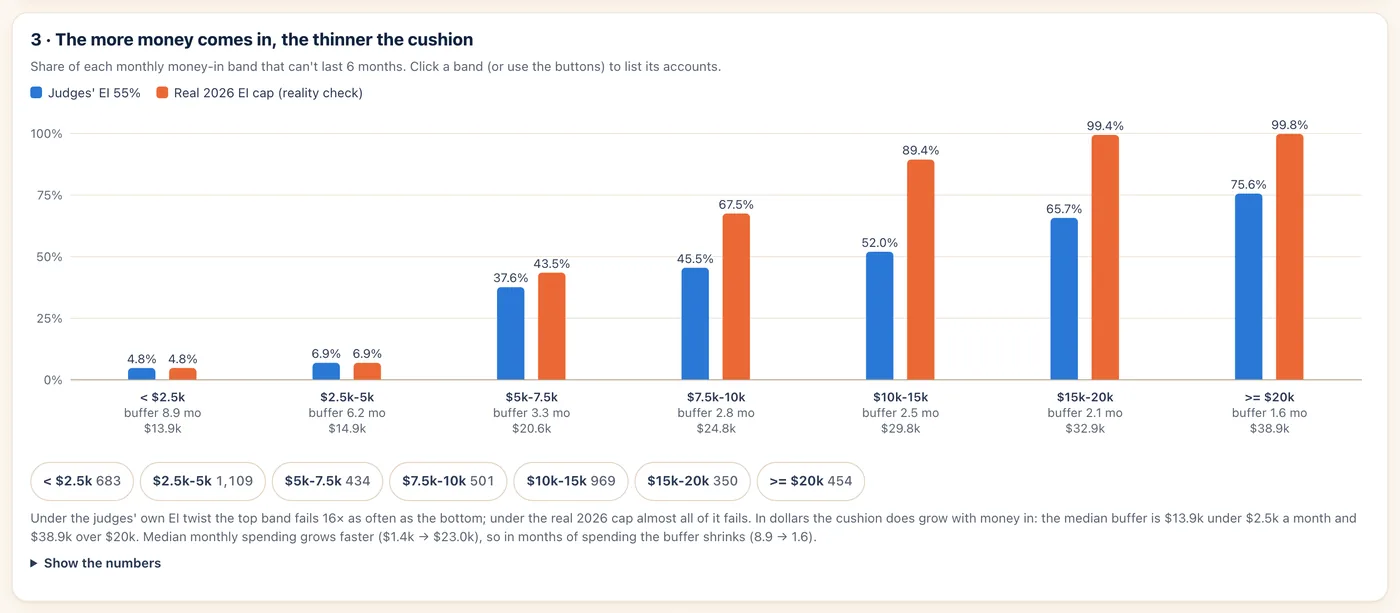
Group the accounts by monthly money in and run the judges' EI 55% twist. The share that can't last 6 months climbs with money in, because spending grows faster than the buffer.
Can't last 6 months on EI at 55%
4.8% 75.6%
from the lowest money-in band (under $2.5k a month) to the highest ($20k a month and up)
Median buffer, in months of spending
8.9 1.6
over the same bands: the cushion shrinks as money in grows
One account
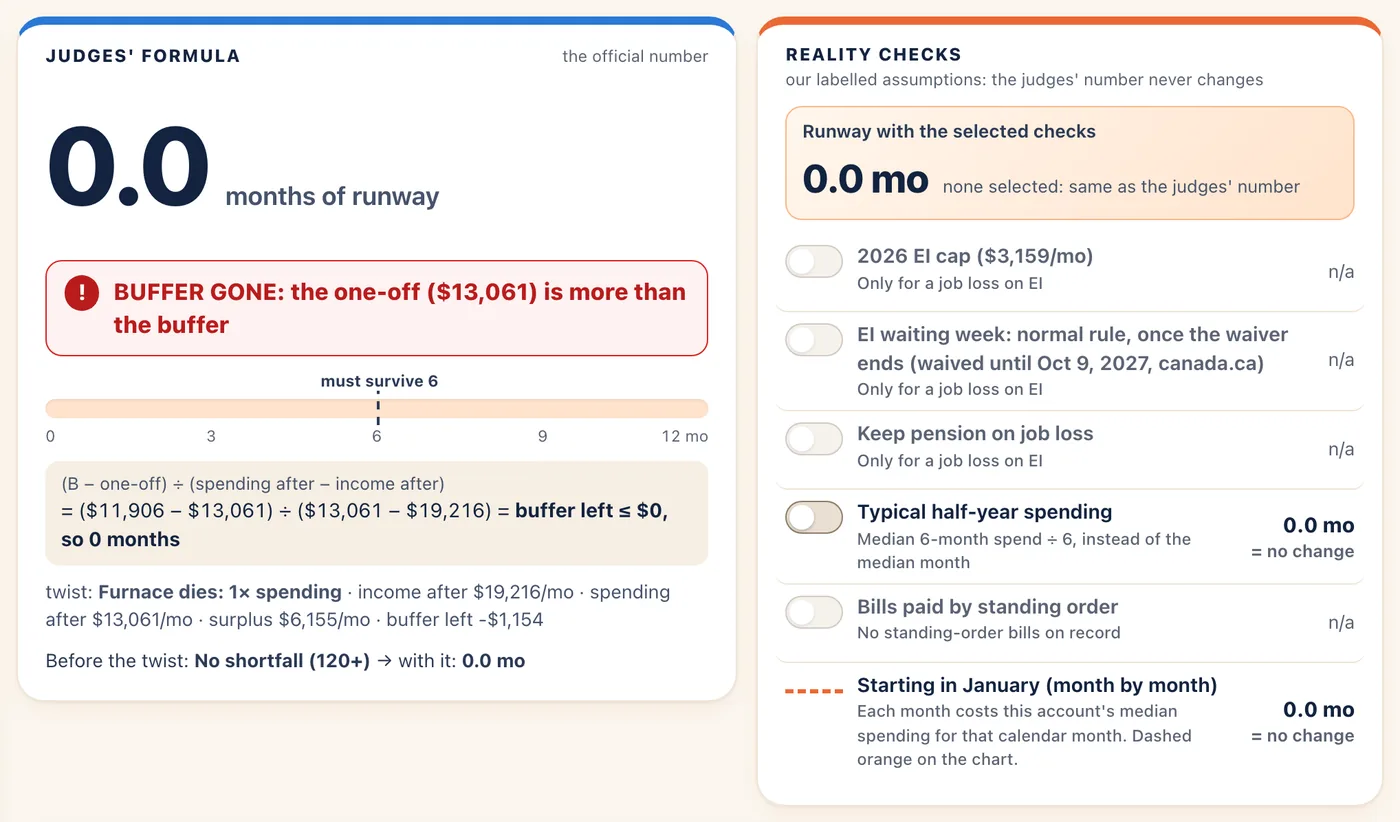
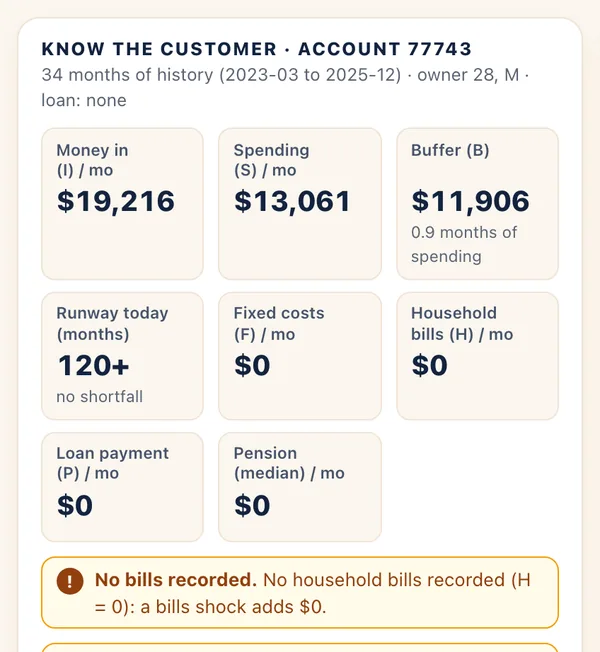
$19,216 a month comes in, yet the buffer covers only 0.9 months of spending. With no shock it never runs short. Then the furnace dies: a repair the size of a month's spending leaves it $1,154 short, and the judges' runway reads 0.0 months.
A big monthly number in is not the same as a cushion. Twin Runway shows both, on the account's own figures.
How it works
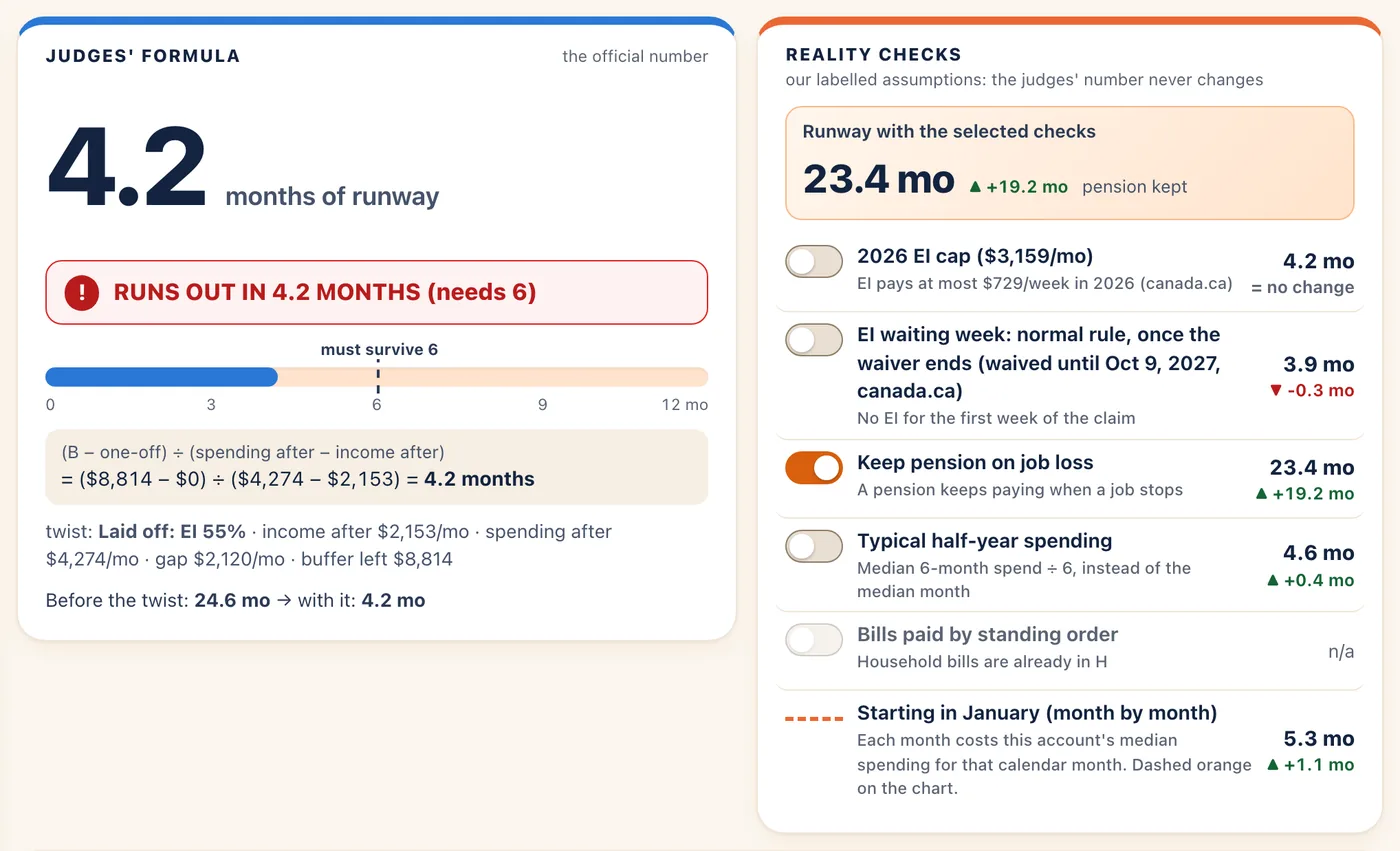
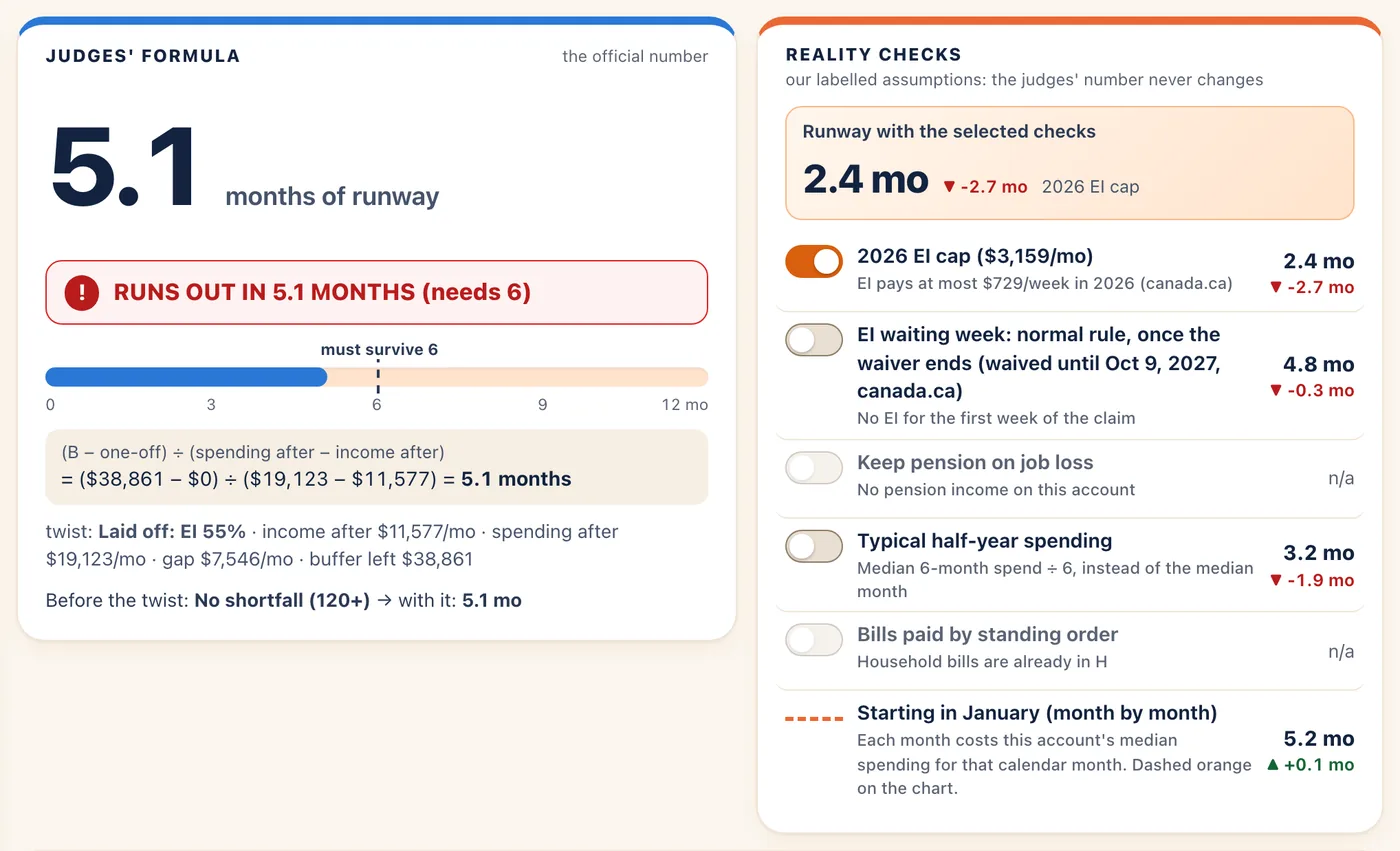
Runway is the judges' formula, exactly as the track brief defines it: (buffer − one-off) ÷ (spending after the shock − money in after the shock). The twist cards apply the judges' shocks: laid off on EI at 55%, a furnace repair of one month's spending, or a job loss with household bills up 15%.
Switchable checks sit next to the official number, each labelled as our assumption, so the judges' number never changes: the real 2026 EI cap ($729 a week), keeping a pension on job loss, typical half-year spending, bills paid by standing order, and a month-by-month start in January.
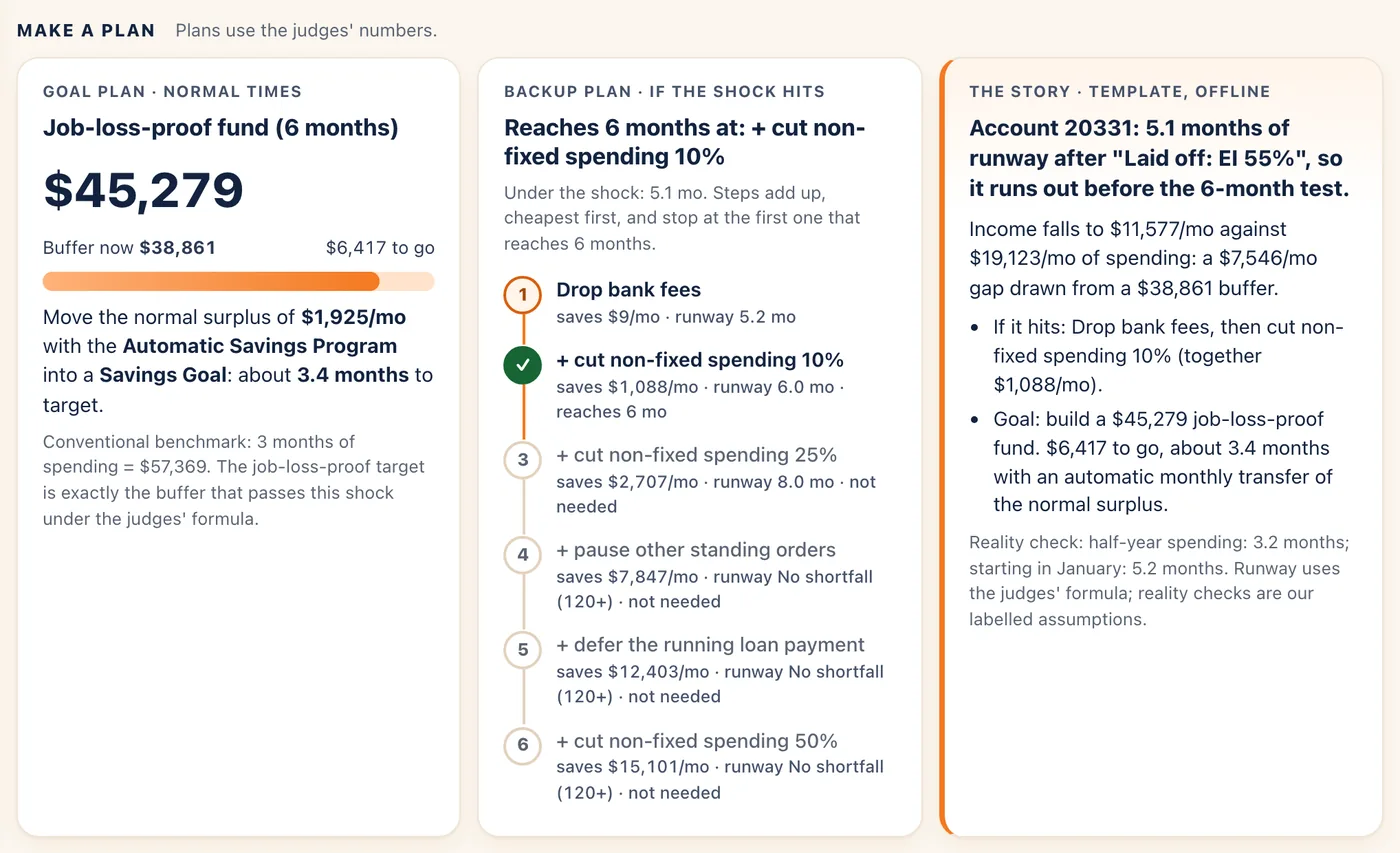
The goal plan sizes a job-loss-proof fund that passes the shock on the judges' formula, and fills it with an automatic monthly transfer of the normal surplus. The backup plan is a ladder of steps, cheapest first, that stops at the first one reaching 6 months. Across the portfolio, 1,192 of the 1,555 failing accounts that still have a buffer get back to 6 months by cutting a quarter of spending or less.
A watch flag beside the runway, not a credit score. It gives one point for each of 4 rules over the account's last 6 months, and from 2 points the apps show it as a warning:
The 2025 evidence
Every score is taken as it stood at the 2024-12 snapshot, on the 3,847 accounts rated then and still active in 2025. Of those, 75 first went overdrawn in 2025, and 28 of those 75 had passed the judges' 6-month test at the snapshot.
On a 10% watch-list (385 of 3,847 accounts), how many of the 75 each ranking catches
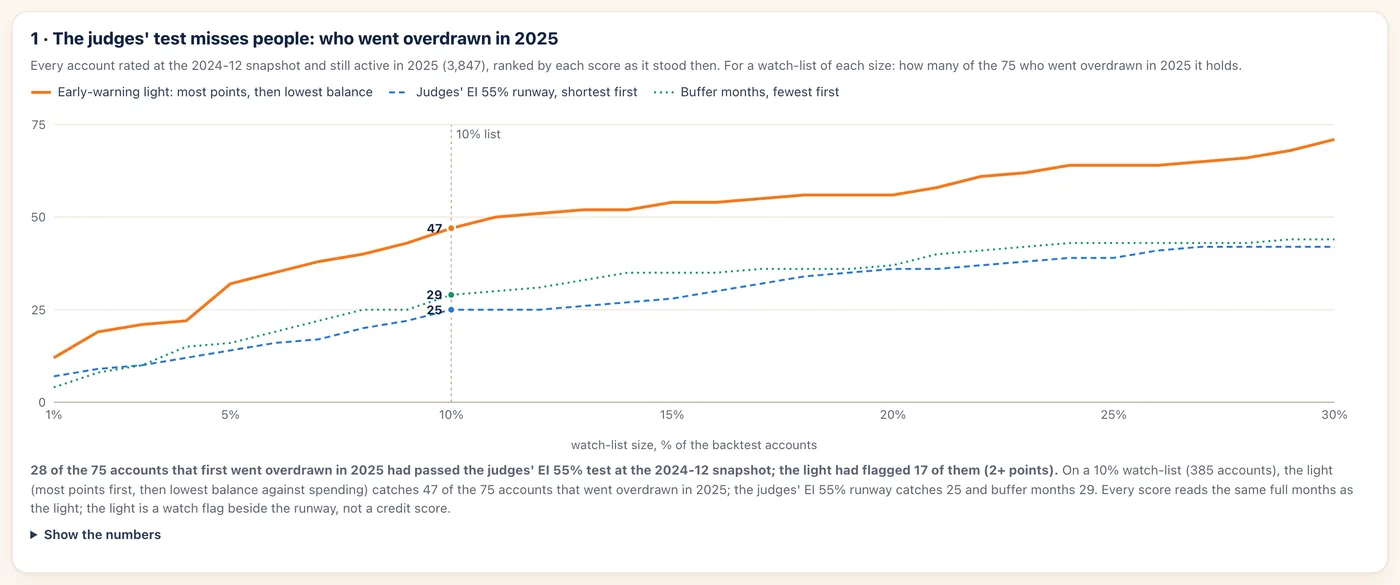
Gradient boosting on 13 features, trained on 2024's outcomes, catches 47 on the same 10% watch-list: about as many overdrafts as the light, but not all the same ones. Both lists catch 38 of them, and each catches 9 the other misses. This data can't tell the two rankings apart, so both apps keep the 4 rules anyone can read.
How it's built
The judges' numbers match on all 4,500 accounts in Python, TypeScript and SQL (DuckDB).
One deterministic engine computes every number: the judges' runway, the shocks, the reality checks, the plans, the light and the backtest. The test suite recomputes every figure the docs and this page quote.
The engine, ported to TypeScript, runs in the browser offline: no keys, no network. Parity tests check it against the Python engine's outputs.
The judges' numbers as plain SQL, run offline in DuckDB or in a Snowflake warehouse.
In the Streamlit app, Gemini can reword the story over the engine's numbers. It never computes a number: if its text has a figure the engine didn't give it, the app shows its built-in template instead.